
Published by Adrian Vogel · Reading time: approx. 8 minutes · As of: September 2026 · Jurisdiction: Germany (with brief notes on Austria and Switzerland)
A note before we start: This article is a general, researched overview and is not a substitute for legal advice. Whether a claim exists in an individual case depends on the specific circumstances and belongs in expert hands (a lawyer specialising in traffic law, a consumer advice centre, a motor-trade arbitration board).
Bad Luck Twice Over, and I Was the One Affected
First, a disclosure: the case this article is about is not a customer's, but my own. I am the founder of OWNAMIC, and within a short space of time I had serious bad luck twice. Two cars I had bought from a dealer each suffered a major engine failure within the statutory warranty period. That something like this happens twice in a row is a big coincidence. That both times it ended with the car going back to the dealer was not: in both cases I could prove precisely when the defect had first appeared, because I had documented everything about the vehicle in OWNAMIC.
In the first case, the AdBlue/SCR system kept triggering the same fault. At every workshop visit I asked for the raw fault-memory readout and filed it on the vehicle object. That way I could show, even after the warranty period had expired, that the same fault had first appeared during it. In the second case, the car was losing a great deal of oil. I documented every oil-level measurement with date and mileage, and the series quickly showed that the dealer had to take the car back.
I am not telling this to claim that documentation wins every case. I am telling it because I felt in my own bank account how much can hang on one dated line with a mileage reading. And of course I am a party in this story. Read it with that in mind.
The story is also a lesson about a single point in German, Austrian and Swiss sales law: almost everything turns on whether a defect was already "present in embryo" at handover, and who can prove it.
The Legal Position in Plain Language (as of 2026)
Statutory warranty is not a guarantee. The statutory warranty (in legal terms: liability for material defects, §§ 434 et seq. of the German Civil Code, BGB) is the seller's statutory obligation to stand behind the item being free of defects at handover. It always applies when you buy from a dealer and cannot be argued away. A guarantee, by contrast, is a voluntary promise by the manufacturer or dealer with freely designed conditions. Anyone who is told that a "guarantee" claim has been rejected has by no means lost their statutory warranty rights.
Defect or wear? A material defect exists if, at handover, the vehicle did not have the agreed quality or the usual quality that could legitimately be expected (§ 434 BGB). In its judgment of 9 September 2020 (VIII ZR 150/18), the BGH held that ordinary wear corresponding to age, mileage and quality class, and not impairing road safety, does not constitute a material defect. A defect exists only where the symptom can be traced to atypical wear or to an underlying "root defect".
The core: § 477 BGB. If a defective condition becomes apparent within one year of handover, it is presumed that the goods were already defective at handover. You do not have to prove that the defect was there "from the start"; the dealer has to prove the opposite. Since the reform of sales law on 1 January 2022 this period is 12 months (previously: 6 months). Once it expires, the burden of proof flips back.
The BGH confirmed and sharpened this in two judgments of 6 May 2026 (VIII ZR 73/24 and VIII ZR 257/23): the presumption already applies once a "manifestation of a defect" appeared at all within the period. The mere theoretical possibility that the cause could also have arisen after handover does not rebut it. In case VIII ZR 73/24, a vehicle bought from a dealer in August 2020 burned out completely "a few weeks after handover", according to BGH press release no. 077/2026, and the expert considered the cause to be "either a technical defect or other circumstances such as an animal bite on a fuel line or arson". Because a technical defect was "at least also" a possibility, the presumption of § 477 BGB applies and the seller must provide full proof to the contrary.
That makes tangible why the first documented point in time matters so much. Anyone who can show that the defect appeared within the first year only has to prove the manifestation of the defect, not its cause. A dated diagnostic report or a dated series of measurements does exactly that. If the same fault keeps recurring, there is a strong case for a single root defect that was already present at handover. And once the first year is over, continuous documentation can show that the first manifestation still fell within the period, as in my first case.
First supplementary performance, then rescission. You cannot demand your money back the moment a defect appears. § 437 BGB lays down an order: first you must give the seller the opportunity to remedy the defect, with a reasonable deadline, in practice often around two weeks (§ 439 BGB). Only if that fails, is refused or is unreasonable can you rescind or reduce the price (§§ 440, 323 BGB). Under § 440 sentence 2 BGB, a repair is deemed to have failed "after the unsuccessful second attempt", and the BGH (VIII ZR 351/19) generally requires that a second repair attempt be waited for.
Limitation. Claims for defects ordinarily become time-barred two years after handover (§ 438 BGB). For a used car, the dealer may shorten this to one year in dealings with consumers; under the BGH's case law (VIII ZR 78/20) this is currently still permissible. The limitation period and the burden-of-proof period are two different things, though: even with a warranty shortened to one year, the 12-month reversal of the burden of proof is unaffected. Where defects have been fraudulently concealed, the limitation period is extended (§ 438 (3) BGB).
Compensation for use. On rescission, you get the purchase price back but must have the kilometres driven set off. The accepted formula is:
gross purchase price × kilometres driven ÷ expected (remaining) total mileage
Example: purchase price €50,000, 1,000 km driven, expected total mileage 250,000 km ⇒ €200 compensation for use. The formerly common flat rate of 0.67 % of the purchase price per 1,000 km is no longer accepted as the standard model by many courts; today courts differentiate more by vehicle type (0.4 % to 1.0 % per 1,000 km).
Austria and Switzerland. In Austria the Consumer Warranty Act (Verbrauchergewährleistungsgesetz, VGG) has applied since 1 January 2022: a two-year warranty period, a one-year presumption period, and for used goods a shorter period only if it is at least one year and individually negotiated. In Switzerland the Code of Obligations imposes a strict duty to notify defects: they must be reported immediately after discovery, usually within a few days, or the item is deemed accepted (Art. 201 OR). In second-hand purchases the warranty is often contractually excluded; such an exclusion is invalid, however, if the seller fraudulently concealed defects (Art. 199 OR). There in particular, prompt, documented proof of the notification is decisive.
What the Documentation Actually Achieved in My Cases
An AdBlue/SCR problem is treacherous because it can often be "clicked away": a warning appears, the workshop reads the fault memory, clears the message, everything runs again. Until the next time. Anyone who only reports by phone and takes no reports home is left empty-handed when the fault escalates into an engine failure after the period has expired. In my case, a documented chain formed instead: fault code X on day A at mileage K1, the same code on day B at K2, and so on. When the engine later gave up, the decisive question, "Did the fault already appear within the period?", was no longer a question of memory but of evidence. I did not have to remember anything. I only had to open the file.
Important, and honest: an exactly matching, published German court ruling in which a recurring AdBlue/SCR warranty fault leads to rescission on the strength of diagnostic reports alone could not be substantiated in the accessible sources; most publicly documented AdBlue/SCR rulings (for instance Higher Regional Court of Braunschweig, 10 U 4/22) concern the diesel emissions scandal and manufacturer liability, not the dealer's warranty. (Evidence level: researched.) Legal specialists do agree, however, that a "persistent, recurring defect" is a strong argument that it was already present at handover, and that diagnostic reports with date and mileage are the central piece of evidence for this.
With oil consumption, the amount decides whether there is a defect, and that can only be proven with a clean series of measurements. The Local Court of Halle (Saale) affirmed a material defect at a consumption of 1.43 l per 1,000 km, allowed rescission and held that the buyer in a consumer sale did not have to pay compensation for use (judgment of 8 December 2011, 93 C 2126/10). Conversely, one lawyer, citing older case law, saw no certain defect at around 0.94 l per 1,000 km. The line runs through the detail, and that is exactly where a dated series of date, mileage and quantity topped up is worth its weight in gold.
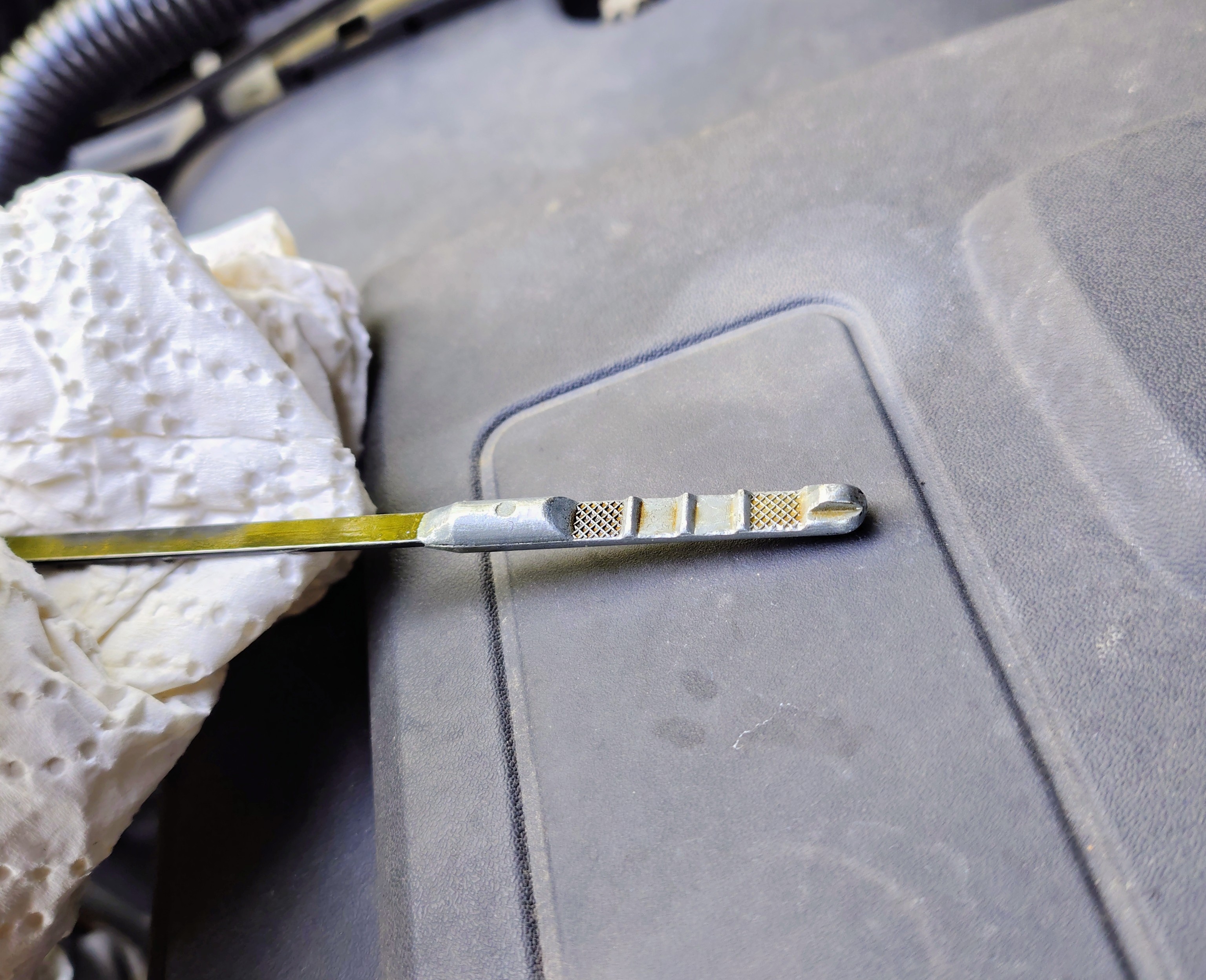
On 6 September 2017 the Higher Regional Court of Stuttgart (4 U 105/17) held that a used car that consumed just under 1 l of oil per 1,000 km was already defective at the passing of risk, because the excessive consumption was due to the engine's design and was therefore "by its nature … present from the beginning". The buyer was allowed to rescind; alongside the expert opinion, his workshop invoices for repeated visits played a role. (Evidence level: evidenced. Note: the case concerned the old law before 2022, but its substance carries over directly.) In my second case it was exactly such a series that cut the dispute short: date, mileage, quantity topped up, every time. The trend showed an atypical consumption present from the start, and the discussion about whether that was "normal for the age" was quickly over.
Cases are rarely lost because the law is bad, by the way. In the researched negative cases (among them the Higher Regional Court of Düsseldorf and the Regional Court of Heidelberg), buyers failed because the defect could not be shown to be atypical, because the point in time remained open, because no deadline for supplementary performance was set or the dealer was given no opportunity to inspect, or because the buyer kept driving and blurred the cause. One court even declined to treat the clearing of the fault memory as spoliation of evidence because the other side had alternative diagnostic reports. Anyone who secures reports protects their evidential position even if data is lost later.
What Counts as Evidence
Strong evidence: diagnostic reports and fault-memory printouts with date and mileage, workshop orders and invoices that record the symptom, date and mileage, written notices of defect with provable receipt, dated measurement logs, photos and videos with timestamps, independent expert opinions, and a "defect diary" with date, time, mileage and operating condition. Weak evidence: mere memory ("that was sometime in spring"), unsupported assertions without date or mileage, purely verbal defect reports, and verbal promises by the seller without a record.
The typical buyer mistakes: reporting the defect only by phone, not taking a readout report home, simply driving on after the fault appeared, having the fault memory cleared without securing a report first, setting no deadline or an unrealistically short one for supplementary performance, and letting the limitation period or the 12-month period lapse.
Two figures show how much money is at stake: the average used-car purchase price in 2025 was €18,310 according to the DAT Report 2026, and if a replacement engine has to be fitted, the total cost is "often between 5,000 and 12,000 euros" according to industry overviews. A low-threshold route is offered by the just under 100 motor-trade arbitration boards: for 2019 the ZDK reported 8,584 applications, of which 90.8 % were settled in preliminary proceedings. The procedure is free of charge for consumers, and filing suspends the limitation period.
Further reading: carrying vehicle value, loan and running costs forward in your net worth – the Big Picture in OWNAMIC
Checklist: What to Document on the Vehicle from the Day of Purchase
- Purchase documents: purchase contract, handover report, invoice, advert text/screenshots, all assured properties ("new MOT", "full service history", "accident-free").
- The exact handover date. It is the starting point for the 12-month period and the limitation period.
- At every workshop visit, have the diagnostic report with date and mileage handed over and file it. Do not have the fault memory cleared prematurely.
- Workshop orders and invoices in full.
- Measurement series for creeping defects (oil or coolant consumption): every measurement with date, mileage and quantity.
- Defect diary with date, time, mileage, operating condition and symptom.
- Photos and videos with timestamps.
- Written notice of defect with a deadline and provable receipt (e.g. registered mail). File a copy.
- All correspondence with the dealer.
- Keep an eye on the deadlines: the 12-month reversal of the burden of proof, limitation (1 or 2 years), repair deadlines you have set. In Switzerland additionally the immediate duty to notify.
What This Looks Like in OWNAMIC
OWNAMIC is not legal advice and promises no outcome in court. But it does exactly what the cases above show to be decisive: it keeps the evidence where it belongs. Every car is its own object, on which the purchase contract, invoices, reports, measurements and photos come together, with date and mileage, in a traceable chronology, and with reminders of warranty, limitation and self-set repair deadlines.
Documentation does not win a case on its own. But it turns "I think it was already like that in the summer" into "here is the report from 14 June at 62,300 km". And in an area of law where almost everything hangs on the point in time and on proof, that is often the difference between rescission and being left holding the damage.
Disclaimer
This article is for general information and is not a substitute for individual legal advice. The legal position described (as of 2026) may change through new legislation and rulings and has been simplified. Whether claims exist in your case and how you should proceed is something to clarify with a lawyer specialising in traffic law, a consumer advice centre or a motor-trade arbitration board. OWNAMIC accepts no liability for the legal assessment of individual cases and promises no particular outcome of warranty disputes.
Sources
- BGB §§ 434, 437, 438, 439, 440, 441, 474, 477 – gesetze-im-internet.de / dejure.org
- BGH, judgments of 6 May 2026 – VIII ZR 73/24 and VIII ZR 257/23 (reversal of the burden of proof, § 477 BGB), press release no. 077/2026 – bundesgerichtshof.de
- BGH, judgment of 9 Sept 2020 – VIII ZR 150/18 (wear is not a defect)
- BGH, judgment of 12 Oct 2016 – VIII ZR 103/15 (root defect / symptom of a defect)
- BGH, judgment of 26 Aug 2020 – VIII ZR 351/19 (second repair attempt)
- BGH, judgment of 18 Nov 2020 – VIII ZR 78/20 (shortening to 1 year permissible)
- BGH, judgment of 29 Apr 2015 – VIII ZR 104/14 (non-transparent limitation clause in standard terms)
- Higher Regional Court of Stuttgart, judgment of 6 Sept 2017 – 4 U 105/17 (oil consumption as a material defect) – autokaufrecht.info
- Local Court of Halle (Saale), judgment of 8 Dec 2011 – 93 C 2126/10 (oil consumption, no compensation for use)
- Higher Regional Court of Braunschweig, judgment of 14 Nov 2022 – 10 U 4/22 (AdBlue/SCR in the emissions scandal; note on the distinction)
- § 477 BGB / reversal of the burden of proof – it-recht-kanzlei.de, haufe.de, IHK Karlsruhe
- ZDK motor-trade arbitration board statistics 2019/2020 – kfzgewerbe.de
- Federal Motor Transport Authority (KBA), press release no. 01/2026 of 6 Jan 2026 (car ownership changes 2025)
- DAT Report 2026 (used-car prices) – dat.de, adac.de, auto-medienportal.net
- Engine failure / replacement engine costs – industry overviews (automotivemarket.de, carpr.de)
- Compensation-for-use formula – iww.de, verkehrslexikon.de, autorechtler.de
- Austria: VGG – wko.at, ombudsstelle.at
- Switzerland: OR warranty / duty to notify / exclusion – law.ch, axa.ch, morandischnider.ch
- Diagnostic report as evidence – kfz-dietrich.com, motor-rechte.de, johanna-swist.de, verkehrsrechtsiegen.de