Published by Adrian Vogel · Reading time: approx. 4 minutes
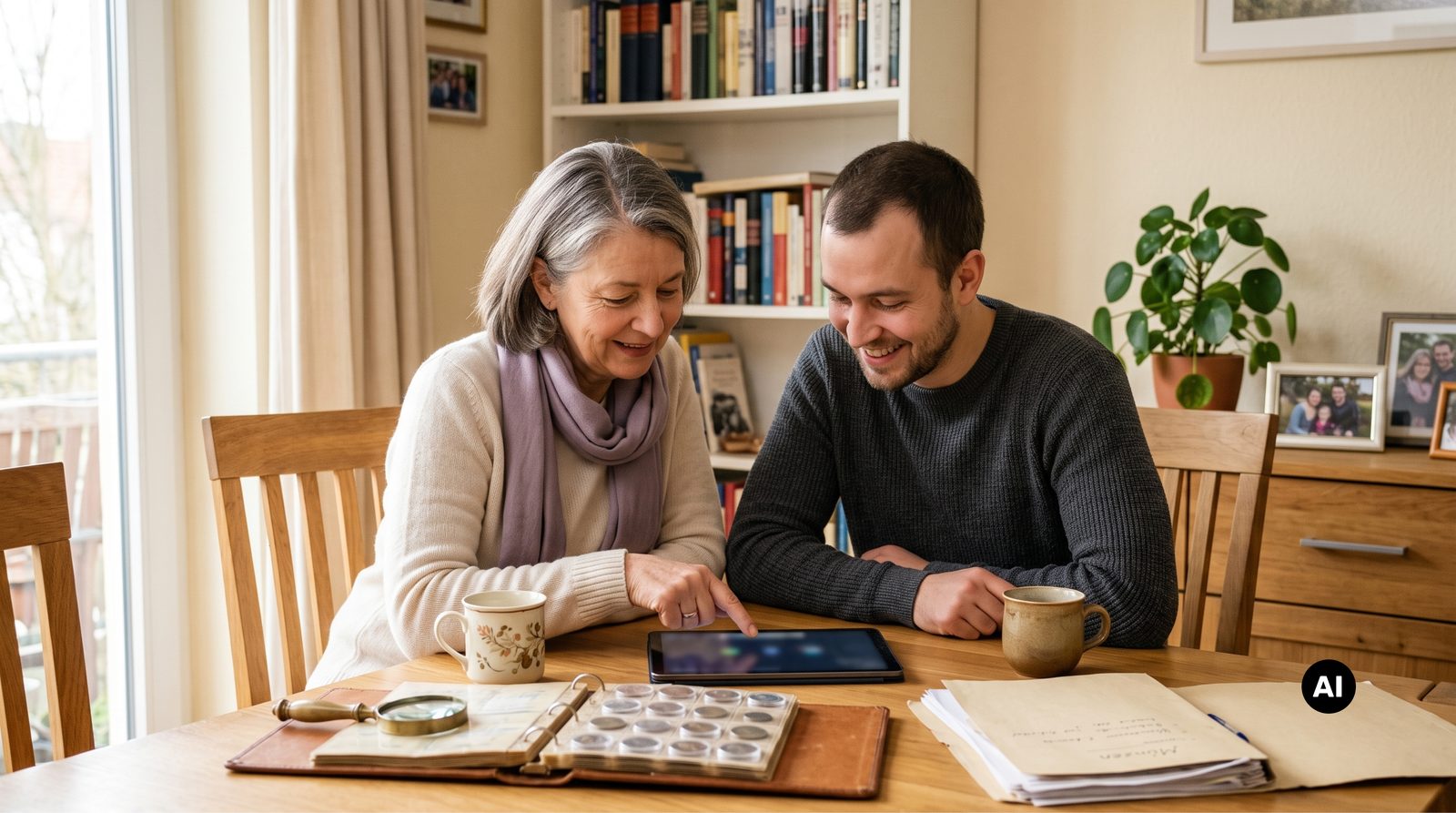
One Set of Possessions, Several People Involved
Most things have exactly one owner. But many situations in life involve more than one person. Three siblings inherit a house full of collections, and none of them knows what is where. A family buys and repairs things over the years, and the receipts sit scattered across three mailboxes. Four neighbours jointly own six power drills, but nobody knows who currently has the ladder. Until now, this ran on spreadsheets sent by email, photos in the WhatsApp group, or a shared account in which everyone can change everything. The first is unmanageable, the second is fleeting, the third is a loss of control.
What a Shared Space Is
A Shared Space is a place in OWNAMIC into which several users contribute objects from their own inventory. You create a space, invite up to four other people by link, and every member decides for themselves which objects or collections they make visible there.
The important word is contribute. An object is not copied, not transferred and not given out of your hands. It stays in your inventory, under your control. The space only displays it. Withdraw it, and it disappears as if it had never been there. Leave the space, and you take all your objects with you.
What the space adds is the shared view: the same objects, photos, descriptions and condition for everyone, plus analyses across the entire inventory of the space.
The One Principle That Carries Everything
Nobody ever changes, deletes or exports an object that is not theirs.
That sentence is not a marketing line but a rule that sits so deep in the system that it cannot be worked around, and one you will find again in our Terms and Conditions. For every other member, a Shared Space is a view, not a workspace. They can look, compare, evaluate. They cannot edit, delete, export or transfer. Anyone who wants to change something about an object that is not theirs asks the owner. Exactly as in real life.
We deliberately built no role model with graduated permissions. Roles lead to precisely the question nobody wants to answer: "Who is actually allowed to do what here?" A Shared Space answers it in advance. Everyone may do anything with what belongs to them. And nothing with the rest.
Financial Data Stays Private, Until You Decide Otherwise
The purchase price of an object, its value range, its insured value: these are the most intimate entries in a record of possessions, often more intimate than the object itself. Which is why financial data in Shared Spaces is invisible by default. To everyone. Always.
You contribute a coin collection, and your co-heirs see the coins, the photos, the descriptions, the state of preservation. What you paid, or what value range OWNY has determined, they do not see. Unless you expressly make your financial details visible in this particular space. You decide that per space, only for your own objects, and you can reverse it at any time.
It sounds like a detail. In fact it is the reason the whole thing works. Because the honest answer to "Can we document this together?" is often: "Yes, but I don't want you to see what that cost." Now both are possible at once.
Three Situations We Built This For
The community of heirs. The collection is at the sister's house, the furniture is in the house, the brother has taken the watches into safekeeping. Everyone knows something, nobody knows everything. In a Shared Space, each co-heir contributes what they actually have in hand, and everyone sees the same picture, with photos, descriptions and receipts where they exist. The values stay hidden until those involved are ready to talk about them. We do not promise that a community of heirs will stop arguing. But it argues about the same facts. That is often half the battle.
The family. She bought the washing machine, he the bicycle, the television was both of them, and the child's bike was a present from the grandparents. A Shared Space for the family is what a household ledger is for expenses, only for the things themselves. Whether your partner sees what the bicycle cost is your decision.
The neighbourhood. Four households on one street jointly own equipment that many a hardware store would envy, and every piece of it gets used twice a year. Sharing never fails on willingness. It fails on the question of who currently has the ladder. In a Shared Space, the neighbours see what there is, who it belongs to and what condition it is in. Nobody sees prices, because they are beside the point.
Lending with SES
The trickiest moment in lending is not the handover but the return. Especially when something is damaged and memories diverge. "The crack was already there." "No, it wasn't."
For this there is the simple electronic signature (SES), which you may already know from object transfers. When lending, both sides confirm with a one-time code (OTP) what was handed over, when and in what condition. The same on the return. The transaction is then recorded with a timestamp in the object's history, with the owner, because the object is theirs.
What that is and what it is not: an SES is not a qualified electronic signature and not legal advice. It is a mutually confirmed, timestamped record of what both sides agreed on in that moment. Evidence instead of a memory. In a neighbourhood that is usually enough, not because it would be needed in court, but because it never gets that far in the first place. OWNAMIC is not a party to any of it. What neighbours agree among themselves, for nothing, for cake or for something in return, remains their business. We document what they confirm to each other.
What Shared Spaces Are Not
- Not a shared account. There are no jointly editable objects. Every object has exactly one owner, and only that owner edits it.
- No release to the outside world. What you contribute to a space is seen by the members of that space. Nobody else. It does not become public, is not used for advertising and is not passed on to third parties.
- Not a marketplace, not a lending platform. There are no reservations, no bookings, no billing. A Shared Space shows what is there. What you make of it is up to you.
And a note on fairness towards the other members: what becomes visible in a space can contain details about people – names on receipts, who gave something as a gift, timestamps. Anyone who joins a space treats those details the way they would want their own treated.
Disclaimer
This article explains in general terms how a shared inventory can be documented; it is not legal advice. Shared Spaces are a documentation aid — not a will, not an estate settlement, and not a statement about who is entitled to what in a community of heirs. For binding arrangements, questions about compulsory shares or a partition sale, talk to a notary, a lawyer specialising in inheritance law, or a consumer advice centre.
The Complete Picture, Even When It Belongs to Several People
"If you know what you have, you don't need more." That sentence is on our home page, and it holds for the individual. Shared Spaces add a second one: those who know together what is there do not have to argue about it.
Further reading: carrying net worth forward with tangible assets – the Big Picture in OWNAMIC